GST compliance in India increasingly depends on accurate digital data. Businesses now manage electronic invoices, GST returns, input tax credit records, e way bills, supplier data and multiple GST registrations through interconnected systems. In this environment, technology for GST compliance can help businesses identify errors earlier, automate repetitive processes and create better control over tax reporting.
Technology does not replace legal judgement. It creates a stronger compliance framework when accounting systems, GST software, internal controls and professional review work together. A well designed system can reduce manual intervention, improve reconciliation and give finance teams greater visibility over GST risks.
Why Technology Has Become Important for GST Compliance?
GST generates large volumes of transaction level data. Businesses with multiple GST registrations may process thousands of invoices every month. Manually checking each transaction creates a significant risk of incorrect tax codes, duplicate entries, missed invoices and reconciliation differences. The GST system itself has become increasingly digital. E invoicing connects invoice data with the GST and e way bill systems, while GSTR 2B provides an auto drafted statement of input tax credit based on supplier reported information and other specified sources.
The GST Council has also recognised the importance of technology in strengthening compliance and audit processes. Digital systems allow tax information to be examined at a transaction level rather than relying only on periodic summaries. Technology therefore serves two purposes. It reduces administrative effort and strengthens the quality of the underlying compliance data.
How Technology for GST Compliance Works?
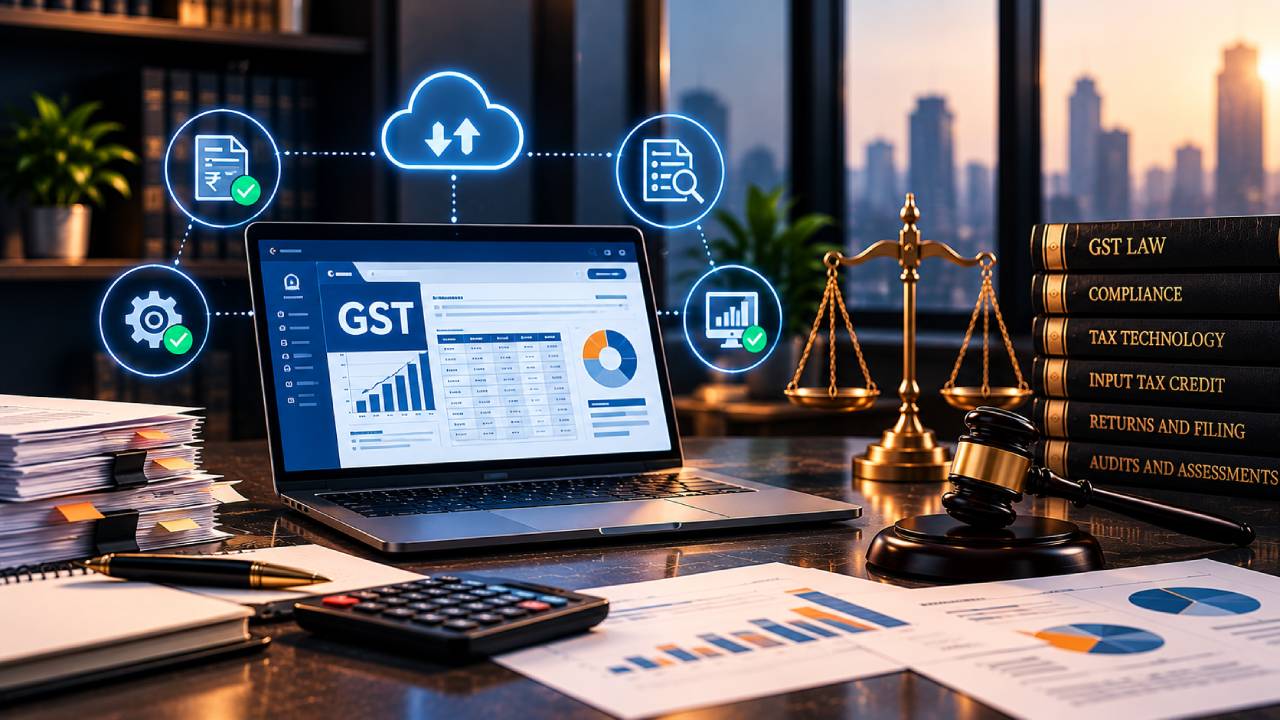
Technology can support GST compliance across the entire transaction cycle. A typical process begins with data captured in an accounting or enterprise resource planning system. GST software can then validate tax fields, identify inconsistencies, generate or integrate e invoices and e way bills, reconcile purchase data with GST records, prepare return information and create compliance reports.
The objective should not be complete automation at any cost. The better approach is controlled automation. Routine calculations and data matching can be automated. Transactions involving unusual tax treatment, high value supplies, complex place of supply questions or uncertain classification should remain subject to human review. This distinction is important because a technically accurate system can still produce an incorrect GST result if the underlying legal assumption is wrong.
Automated Invoice Validation Can Reduce Errors
Invoice errors are one of the most common sources of GST compliance problems. Technology can validate GSTINs, invoice numbers, dates, taxable values, tax rates, HSN or SAC codes, place of supply and other required fields before information moves into the return process. Automated validation can also identify duplicate invoice numbers, missing fields and inconsistencies between accounting records and GST reporting data.
E invoicing provides an important example. The National Informatics Centre explains that invoice information reported through the Invoice Registration Portal is transferred to the GST and e way bill systems. This reduces the need for repeated manual data entry. The result can be a more consistent flow of transaction data from invoicing to reporting.
E Invoicing and Real Time Data Flow
E invoicing has changed the way eligible businesses manage B2B invoice compliance. Instead of creating an invoice in one system and manually reproducing its information elsewhere, businesses can integrate their ERP or accounting systems with the relevant e invoicing infrastructure. The system can validate the invoice, obtain the Invoice Reference Number where applicable and maintain the relevant electronic record.
This reduces duplication of data entry. It can also help identify errors closer to the point at which an invoice is created. For businesses with large transaction volumes, this is particularly important. Correcting an invoice before it enters multiple downstream systems is generally easier than correcting the same error after it affects GST returns, customer records and reconciliation reports.
Technology Can Strengthen ITC Reconciliation
Input tax credit remains one of the most important areas where technology can improve GST controls. GSTR 2B provides an auto drafted ITC statement based on specified supplier reported data, ISD information and import data. GSTN advises taxpayers to reconcile GSTR 2B with their own books and records and ensure credit is not claimed twice or retained where reversal is required.
Software can compare purchase registers with GSTR 2B and classify differences into categories such as matched invoices, missing invoices, value differences, GSTIN differences, amendments and credit notes. This is much more efficient than relying entirely on spreadsheets for high volume transactions. However, an important legal distinction must remain. A match in GSTR 2B does not automatically establish entitlement to ITC in every case. The conditions under Section 16 and restrictions under Section 17 of the CGST Act continue to apply. Technology can identify a matching invoice. It cannot independently establish every legal condition for credit.
Technology Can Improve GSTR 1 and GSTR 3B Accuracy
GST technology can also reduce inconsistencies between outward supply reporting and tax payment returns. GSTR 3B receives system generated information from GSTR 1, GSTR 1A and GSTR 2B for specified fields. Taxpayers can still need to make adjustments where the system generated figures do not fully represent the actual tax position. This is particularly relevant for reverse charge transactions. Certain reverse charge liabilities, including specified import of services situations, may require taxpayer intervention rather than simple reliance on system generated values. A robust compliance system should therefore compare the books, source data, GSTR 1, GSTR 3B and relevant GST portal information before filing. The technology should identify differences for review rather than simply reproduce them.
GSTR 1A Creates Another Opportunity for Error Control
GSTR 1A provides an optional mechanism for correcting or adding specified records before GSTR 3B is filed for the same tax period. From a technology perspective, this creates another control point. A system can compare the original outward supply data with the information prepared for GSTR 1 and identify missing or amended transactions. The finance team can then review whether GSTR 1A should be used before filing GSTR 3B. This type of workflow can prevent small reporting mistakes from becoming part of the final tax liability for the period.
Invoice Management System and Technology Driven ITC Controls
The Invoice Management System has added another important digital control within GST compliance. Under the GSTN framework, recipients can take specified actions on supplier invoices and records appearing in IMS, including accepting, rejecting or keeping records pending. The first GSTR 2B generated using IMS actions was introduced for the October 2024 return period. For businesses with large procurement volumes, technology can help organise these actions instead of relying on manual invoice by invoice monitoring. A useful system can prioritise invoices requiring attention, identify supplier discrepancies and maintain an audit trail of decisions. This becomes particularly valuable where the business has several GST registrations and a central tax team.
ERP Integration Can Create a Single Source of Data
One of the biggest weaknesses in GST compliance is fragmented data. Sales may be maintained in one system. Purchases may sit in another. Logistics data may be held separately. GST returns may then be prepared using spreadsheets. This structure increases the possibility of inconsistent information. ERP integration can create a more controlled data flow. Sales transactions can feed GST reporting. Purchase data can feed ITC reconciliation. Logistics information can support e way bill controls. Invoice data can flow into e invoicing processes. The benefit is not simply speed. It is consistency. A business can also create a central dashboard showing filing status, unresolved reconciliation differences, vendor issues, tax liabilities and exceptions across GST registrations.
Automated Vendor Compliance Monitoring
A supplier's compliance behaviour can affect the recipient's GST position. Technology can monitor supplier reported invoices, GSTR 2B appearance, amendments, credit notes and other relevant information. Where a supplier repeatedly fails to report invoices correctly, the system can flag the relationship for review. This allows the tax team to communicate with vendors before month end rather than discovering the issue during annual reconciliation. Vendor monitoring is especially useful for businesses with hundreds or thousands of suppliers. It should, however, remain a risk management tool rather than a substitute for checking the legal conditions governing ITC.
Technology Can Reduce Duplicate ITC and Reversal Errors
Duplicate ITC can arise when the same invoice appears more than once because of amendments, credit notes, multiple data imports or manual entries. Automated matching can use invoice number, supplier GSTIN, date, taxable value, tax amount and other fields to identify possible duplicates. The system can also flag credit notes, reversals and previously adjusted invoices. This creates a stronger control over the movement from purchase records to the final ITC reported in GSTR 3B. Human review remains important where an invoice has been amended or where the accounting treatment differs from the GST treatment.
Data Analytics Can Identify High Risk Transactions
Technology can move GST compliance beyond simple return preparation. Data analytics can identify unusual patterns such as sudden increases in ITC, large variations in tax liability, repeated amendments, unusual credit notes, inconsistent tax rates or transactions involving high risk vendors. These patterns can then be reviewed by the tax team. For example, a sudden increase in ITC in one GST registration may not necessarily indicate an error. It could arise from a genuine business event. Analytics should therefore identify the transaction for investigation rather than automatically treating it as non compliant.
This is where professional judgement becomes essential. AI Can Support GST Compliance, But It Should Not Replace Legal Review Artificial intelligence can assist with document classification, reconciliation, anomaly detection, data extraction and exception management. It can process large volumes of information much faster than manual review.
However, GST compliance is not purely a data exercise. A machine may identify two invoices as similar but cannot always determine whether they represent the same legal transaction. It may flag a tax rate difference without understanding a classification ruling or notification. It may identify ITC in GSTR 2B without establishing whether all statutory conditions for credit have been satisfied. AI should therefore operate within a controlled framework. The best model is technology supported compliance with appropriate human oversight.
Technology Can Improve GST Audit Readiness
A business should not begin preparing for an audit only after receiving an audit notice. Digital systems can maintain records, reconciliation statements, invoice histories, return data and supporting documents in an organised manner. This can help the tax team respond more efficiently when questions arise. Technology can also create an audit trail showing who reviewed a transaction, what action was taken and when a correction was made. For businesses subject to departmental scrutiny or audit, good data governance can make the difference between quickly explaining a discrepancy and spending weeks reconstructing historical transactions.
Common Technology Related GST Compliance Risks
Technology itself can create compliance problems if it is poorly configured. A wrong tax rate in an ERP master can affect thousands of invoices. An incorrect HSN or SAC mapping can repeat the same error across multiple transactions. A faulty integration can duplicate records. An outdated GST rule engine can generate incorrect results after a legislative change. There is also a risk of excessive reliance on automated reconciliation. A software match should never be treated as conclusive legal proof of ITC eligibility. Businesses should therefore maintain configuration controls, access controls, approval workflows, system testing and periodic review of tax logic.
How Businesses Should Implement GST Technology
Technology implementation should begin with a review of the existing compliance process. The business should identify where errors currently occur. These may involve invoice creation, vendor data, reconciliation, return preparation, e invoicing, e way bills or inter GSTIN transactions. The next step is to determine which activities can be automated and which require professional review. The technology should then be tested using actual transaction scenarios before full implementation. Businesses should also establish ownership. Finance, tax, IT, procurement and commercial teams may all influence GST data. Clear responsibility reduces the possibility of errors being passed between departments. Periodic review is equally important because GST procedures and portal functionality continue to evolve.
Role of GST Compliance Professionals in a Technology Driven System
Technology can improve the quality and speed of GST compliance, but it does not remove the need for tax professionals. A tax professional can review whether system rules correctly reflect the law, assess unusual transactions, interpret notifications and judicial decisions, examine disputed ITC and advise on complex GST positions. Businesses using GST compliance consultants should therefore evaluate both the technology and the legal review framework supporting it. The strongest compliance environment combines accurate source data, reliable automation, documented controls and expert review.
Technology Should Reduce Risk, Not Merely Reduce Work
A common mistake is to measure GST technology only by how many hours it saves. Time savings matter, but the more important question is whether the system improves the quality of tax compliance. A good technology framework should reduce duplicate data entry, improve reconciliation, identify exceptions early, maintain evidence and create accountability. It should also make it easier for senior management to understand where GST risks exist. Technology should therefore be treated as part of the organisation's internal tax control system rather than simply as filing software.
Future of Technology for GST Compliance in India
GST compliance is moving towards increasingly integrated and data driven processes. E invoicing, e way bills, GSTR 2B, IMS, automated return information and ERP integrations have already created a more connected tax environment. The next stage is likely to involve greater use of analytics, automated exception management and AI supported review. For businesses, this means GST compliance will increasingly depend on the quality of their underlying transaction data. Organisations using taxation lawyers alongside technology can also assess complex legal positions before those positions are converted into automated system rules. The future of GST compliance is therefore unlikely to be completely manual or completely automated. It will be a combination of digital controls and human legal judgement.
Conclusion
Technology can significantly improve GST compliance by reducing repetitive data entry, strengthening invoice validation, improving ITC reconciliation, integrating ERP systems, monitoring vendors and identifying unusual transactions. The greatest benefit comes when technology is designed around the actual legal requirements of GST.
Automation should not be treated as a guarantee of compliance. A system can process incorrect data perfectly. It can also apply an incorrect tax rule consistently if its configuration is wrong. Businesses should therefore combine technology with proper tax governance, periodic reconciliation, documented processes and professional review. The objective is simple: identify errors before they become filing errors, identify filing errors before they become tax disputes, and maintain reliable evidence when the business needs to explain its GST position.
Frequently Asked Questions (FAQs)
Q1: How does technology improve GST compliance?
Technology improves GST compliance by automating repetitive tasks, validating transaction data, reconciling GST records, identifying discrepancies and creating better audit trails.
Q2: Can GST software eliminate compliance errors?
No. Software can reduce manual errors and identify inconsistencies, but incorrect configuration, incomplete data and incorrect legal assumptions can still produce errors.
Q3: How does e invoicing help GST compliance?
E invoicing reduces repeated manual data entry by transferring relevant invoice information through the GST ecosystem. It can improve consistency between invoicing, GST reporting and e way bill processes.
Q4: How can technology improve ITC reconciliation?
Technology can compare purchase records with GSTR 2B and identify missing invoices, duplicates, value differences, credit notes and other discrepancies for review.
Q5: Does GSTR 2B automatically confirm ITC eligibility?
No. GSTR 2B provides information relevant to ITC availability, but taxpayers must still satisfy the applicable conditions and restrictions under GST law.
Q6: What is the role of AI in GST compliance?
AI can assist with document processing, reconciliation, anomaly detection, classification and exception management. It should support rather than replace legal and tax review.
Q7: Can ERP integration reduce GST errors?
Yes. Proper ERP integration can reduce duplicate data entry and create a consistent flow of information between accounting, invoicing, logistics and GST reporting systems.
Q8: How does technology help with GST audits?
It can maintain organised transaction records, reconciliation reports, filing histories and audit trails. This can make it easier to identify and explain discrepancies.
Q9: What is Invoice Management System under GST?
IMS is a GST Portal facility through which recipients can take specified actions on supplier reported invoices and records, including accepting, rejecting or keeping them pending for ITC purposes.
Q10: Can technology monitor supplier GST compliance?
Yes. Systems can monitor supplier invoice reporting and reconciliation data and flag suppliers whose reporting creates recurring ITC discrepancies.
Q11: Can technology monitor supplier GST compliance?
Yes. Systems can monitor supplier invoice reporting and reconciliation data and flag suppliers whose reporting creates recurring ITC discrepancies.
Q12: Why is human review still necessary in GST compliance?
GST involves legal interpretation and factual assessment. Technology can identify patterns and calculate results, but complex questions involving classification, exemptions, ITC eligibility or place of supply may require professional judgement.